How I Built & Launched a Lead Magnet in 3 Hours
I recently built and launched a new lead magnet that feels genuinely aligned with where my brand is heading next. I didn't want to create another generic freebie just to collect emails; I wanted to build something that solves a specific problem and serves as a natural entry point to my work. If you've been overthinking your own, here are the exact steps I took to build and launch it in a single afternoon.
(Please note that my timeline may be shorter because I’ve executed this exact process across different digital products, so don’t compare your speed to mine if you are new to this.)
What Is a Lead Magnet?
A lead magnet is a free resource you offer your audience in exchange for something, usually their email address or a follow. The goal is not to make money directly from it. The goal is to attract the right people into your world and give them a first taste of how you think and what you can help them with.
Think of it as a handshake. It lowers the barrier to entry and builds trust before you ever ask someone to buy anything.
What Does It Do for a Creator Business?
For creators, a lead magnet serves a few key purposes:
It filters your audience. People who download your lead magnet are signaling genuine interest. They’re more likely to convert into paying customers than a follower who just liked a video.
It grows your email list. Social media platforms can change their algorithm or disappear entirely. Your email list is an asset you own.
It establishes your expertise. A well-made lead magnet shows people how you think and positions you as someone worth paying attention to.
What Does It Do for a Consultancy or Service Business?
For consultants and service providers, the lead magnet works slightly differently. Instead of building a broad audience, it’s about qualifying potential clients. A good lead magnet helps the reader self-identify as someone who needs your services, primes them with your framework or approach, and makes the transition to a paid engagement feel natural.
Types of Lead Magnets
The format depends on your audience and what kind of quick win you can deliver. Here are the most common ones:
Workbook. A guided document with prompts and exercises. Good for helping people think through a problem or audit something in their business.
Template. A ready-to-use resource they can plug into their own workflow immediately. Works well if your audience values tools over theory.
Checklist. A simple, actionable list. Best when your audience needs to know what to do, not how to think about it.
Mini guide or PDF. A short written piece that explains a concept, framework, or process. Works well if your strength is in teaching.
Email course. A series of short emails delivered over a few days. Good for building a habit of engagement with your content.
Quiz or assessment. An interactive format that gives people a personalized result. High engagement and strong for filtering the right audience.
The format matters less than the outcome. Pick the one that lets you deliver the clearest quick win for your specific audience.
What I Built
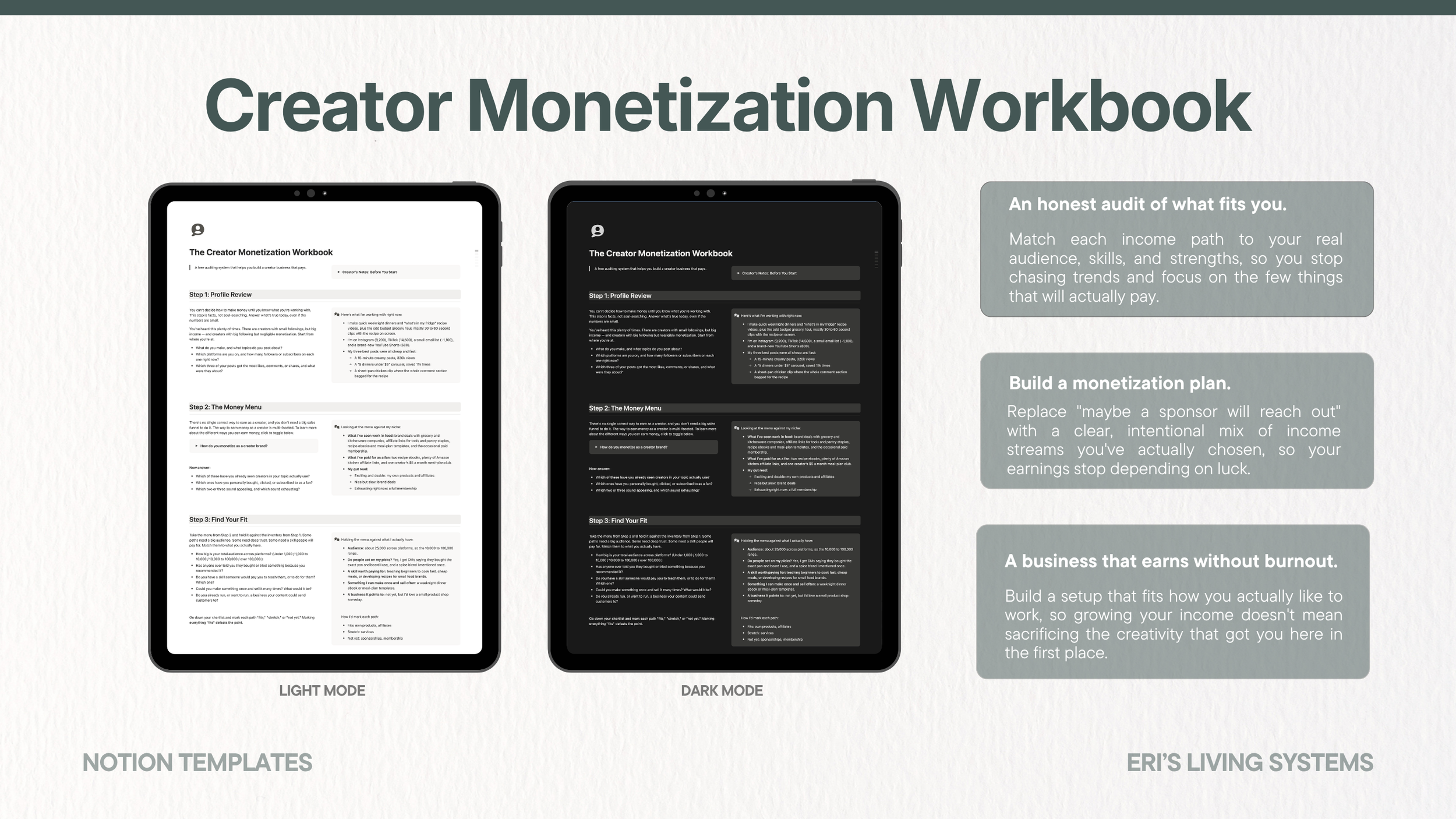
For this build, I created a workbook in Notion designed to help creators get clarity on how to monetize their business. A lot of creators have a brand, but it’s not actually monetizable. This workbook walks them through whether their brand can be monetized, whether there’s a clear direction, or whether they need to pivot and consider other forms of monetization.
I built something similar for freelancing, a client journey workbook that helps service providers understand if their services are aligned with the market and how to execute on what they already know. That received a lot of good feedback, and so I wanted to do something similar for where this account is heading — which is serving creators.
Step 1:
Build the Lead Magnet
The Core Idea
The most important thing about this step is that you actually do it. It’s easy to get stuck overthinking the format, the design, or whether it’s good enough. It doesn’t need to be perfect. It needs to exist.
A lead magnet only needs to be something someone can work through in 30 minutes to an hour. This isn’t arbitrary. Research consistently shows that shorter, more focused lead magnets outperform longer ones. The reason is simple: people will opt in based on perceived value, but they’ll actually complete it based on how much effort it requires. If your freebie feels like a course, they’ll save it for later and never come back to it. Keep the scope tight and the win immediate.
The goal is one clear, concrete outcome for the reader. Not five outcomes. One.
What “Quick Win” Actually Means
A quick win is not just any takeaway. It’s a specific, usable result the reader can act on immediately after completing your lead magnet. The best way to think about it: what is one thing someone could know or do differently in the next hour because of your resource?
You want to make sure that this is a real issue or problem that your audience wants to have a solution to.
For my monetization workbook, the quick win is helping creators audit their brand against simple, concrete questions about earning. By the end, they know whether their brand is set up to monetize, and if not, they have a direction to move toward. That’s a complete thought. That’s a quick win.
Step 2:
Understand Your UVP
Your unique value proposition (UVP) is what people come to you for specifically. A strong UVP answers one question: why should someone choose your resource over anyone else’s?
A UVP has three components:
relevance (it speaks directly to a real problem your audience has)
specific value (it communicates a clear benefit, not a vague promise), and
differentiation (it tells people why you, not someone else).
You don’t need to be unique to the entire world. You just need to be the clearest, most trusted option in your specific corner of it.
It doesn’t even have to be a dramatic differentiator. It could be your tone, your background, your specific niche, or simply the clarity of how you explain things. For this lead magnet, mine is clarity.
Why This Matters for Creators Specifically
A lot of people build creator brands or businesses without ever thinking about the business side. Many creators come to platforms thinking they can easily monetize followers, but followers aren’t money. Monetization is often not correlated with following.
People watch you because they’re entertained, not necessarily because they trust you. People buy from people they trust. This is a critical distinction: entertainment builds audiences, but trust builds customers. Your UVP should live in the trust zone, not the entertainment zone.
This is one of the biggest mistakes I see creators make. There’s a lot of low-effort content that’s easy to mimic, and I see people copy that style without making it their own. You might gain followers, but those followers won’t convert. You become more of a content entertainer than someone with a monetizable audience. That’s the pain point I’m addressing with this workbook, because it’s one I used to think about a lot myself.
How to Find Yours
Ask yourself three questions:
What do people come back to me for, specifically?
What problem do I solve that others in my space talk around but never actually address?
What is the one thing someone would miss if I stopped creating?
Your UVP lives somewhere in the intersection of those answers.
Step 3:
Build Your Copy
Your product copy is not just a summary of what’s inside your lead magnet. It’s the bridge between your audience’s current frustration and the transformation you’re offering. A weak description means people don’t download it, even if the resource itself is excellent. Think of it as the packaging: it doesn’t change what’s inside, but it determines whether someone picks it up.
The Framework
This is a simple structure I use myself. It helps me write faster, repurpose ideas across formats, and adjust depth depending on the context.
Hero line. Start with your unique value proposition and think about the transformation you’re creating. Synthesize that into one punchy, specific sentence. This is the first line of your description. It should make someone immediately think, “that’s exactly what I need.”
Three benefits. Think of three key outcomes tied to that main transformation. Each benefit gets a short header (three to seven words) followed by a two to three sentence description. These should be concrete, not vague. Not “gain clarity” but “know exactly which income stream fits your brand.”
Closing line. End with something that loops back to the transformation. This closes the loop and reminds the reader of what they’re actually walking away with.
Your full structure:
Hero line
Three benefits, each with a header and a short description
Closing line tied to the transformation
Sample (Creator Monetization Workbook)
Quit guessing how creators make a living, and map out exactly how you will.
An honest audit of what actually fits you. Match each income path to your real audience, skills, and strengths, so you stop chasing trends and focus on the few things that will actually pay.
Build a monetization plan instead of a guessing game. Replace "maybe a sponsor will reach out" with a clear, intentional mix of income streams you've actually chosen, so your earnings stop depending on luck.
A business that earns without burning you out. Build a setup that fits how you actually like to work, so growing your income doesn't mean sacrificing the creativity that got you here in the first place.
Work through it once and you'll walk away with a monetization plan that's actually yours, not a copy of someone else's. Come back to it whenever your audience grows or your goals shift, and it'll still point you in the right direction.
Step 4:
Build the Creatives
Your creative assets are the first thing a potential follower or customer sees before they ever read your description. They decide in seconds whether to keep scrolling or stop. A polished, distinct creative builds trust before a single word is read. A generic one signals that your product is probably generic too.
The bare minimum I work with is two assets: a logo and a product listing image. These two cover most use cases across platforms, from Gumroad and Payhip listings to Instagram posts and Pinterest pins.
How to Build Them
Find inspiration. Look at how others in your space present similar products. You’ll notice a lot of people use very similar layouts, and that’s your opportunity. Study what exists, identify the patterns, then deliberately break from them. The more you replicate someone else’s style, the more people will gravitate toward the original. The origin always wins. Build something that is distinctly yours.
Build your templates in Canva. Canva is my primary design tool. Create reusable templates for your logo and product listing so you’re not starting from scratch every time. The goal is a system you can move fast with, not a one-off design you have to recreate for each product.
Optimize as you go. Your first version is a starting point, not a final product. The more you use these templates, the more you’ll notice what works visually for your audience, what feels off, and where you can sharpen your brand identity. Iteration over time is how you develop a recognizable aesthetic.
Step 5:
Choose Your Distribution
At this point you have your template, your copy, and your creatives. The final question is: where does it actually live, and how do people find it? This step could be its own deep-dive depending on your platform and audience, but here’s a practical breakdown of your options.
Two Distribution Routes
Once you know your channel, you need to decide how people actually land on the lead magnet itself. I follow two main distribution strategies. There are many examples of this, but this is what I personally follow:
Creatives to checkout page. Push social media creatives directly to a landing or checkout page. This is faster to set up and more immediate in results, but it requires consistent content output to keep the funnel moving. When you stop feeding it, it stops producing.
Blog + Pinterest route (my current). Write blog content around the problem your lead magnet solves, then use Pinterest to drive traffic to those posts. Pinterest functions more like a search engine than a social platform. Its algorithm takes time to understand your content and audience, and most creators see meaningful traction between three to six months of consistent effort. The tradeoff is that once pins gain momentum, they continue working indefinitely. Content you post today can still drive traffic a year from now. It is a slow burn, but it compounds.
What I’ve Tried
I used to go straight from social media to a checkout page, and it worked for a while until I got exhausted from keeping up with it. Part of it was performance, part of it was burnout from always needing to create new content to keep the funnel alive. So now I’m testing the blog and Pinterest route, which trades short-term speed for long-term sustainability.
Neither approach is wrong. Choose based on your current capacity, your content strengths, and how much of a long game you’re willing to play.
In the past, I was a lot more comfortable simply creating these fun carousels that would gain traction and push a lot of interest into my products. But now, I like to keep it on the low and rely on the hard work I put into this brand when I had more energy to pour into it.
If You Want to Build Yours With Me
If reading through this made you want to actually build a lead magnet, I’m putting together a small three-day sprint to walk through it together.