How to Start Writing Essays for Fun (and Actually Keep Going)
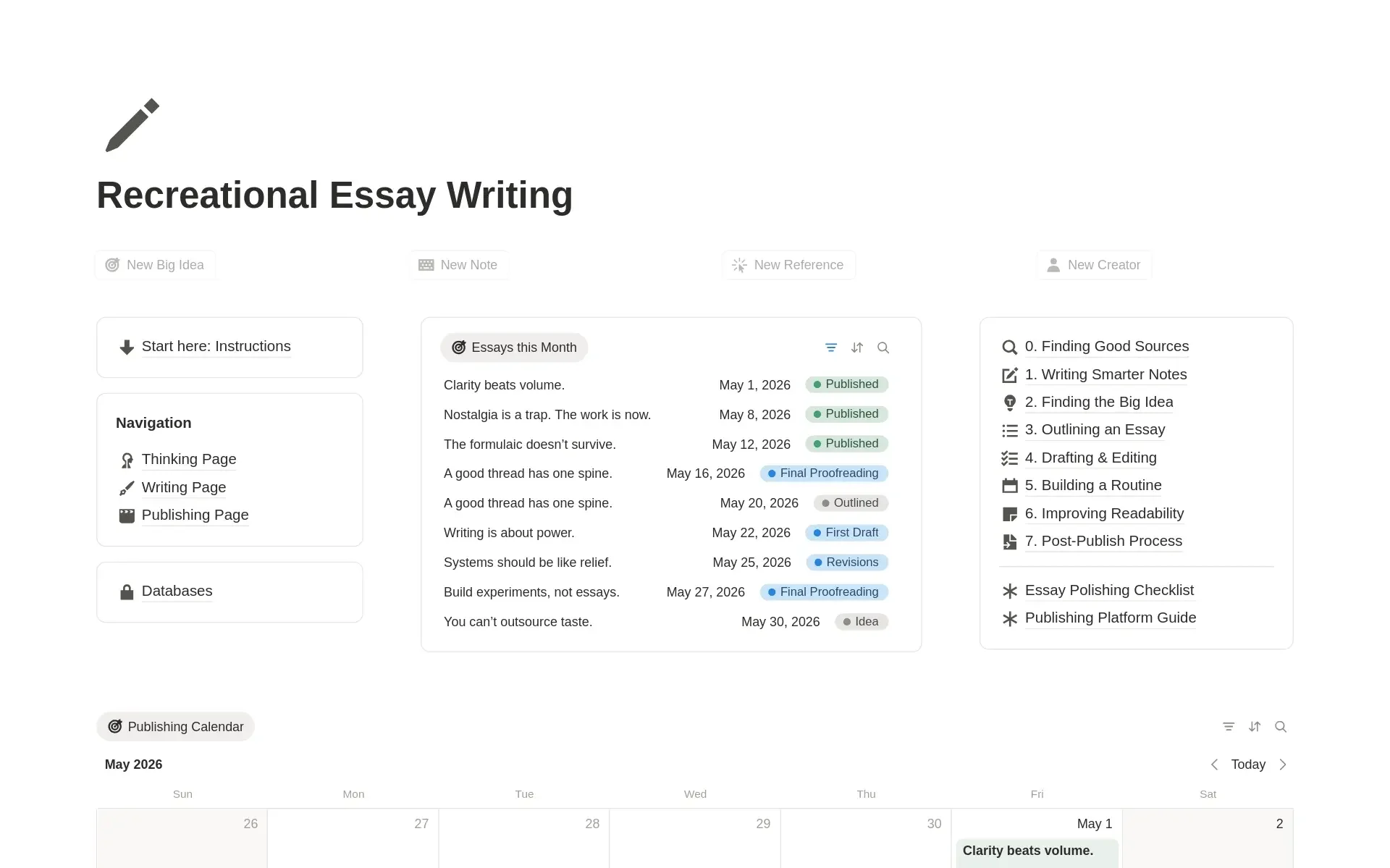
First Published: February 16, 2026 | Updated: February 18, 2026 | Template Version: April 2026
Writing approaches generally fall into two camps:
One group embraces the "just get it done" philosophy: write fast and messy, then iterate toward something better.
The other group prefers the slow lane: careful planning, detailed outlines, and deliberate execution before committing a single sentence to the page.
It’s a spectrum when you get to the practicalities. But when you go to the literature to search for wisdom, you will generally have one or the other recommended to you.
Personally, I think both work but for different parts of the process.
First drafts are difficult, so fast and messy is where it’s most suitable. On the other hand, once you have something written down, your mind gets cleared off the anxieties of getting started and that’s when you can go the slow and thoughtful lane.
It may feel embarrassing at times to publish something that’s not smoothed out by an all-knowing AI. But with levity, I’ll say that publishing and the fear of public humiliation is what can help you become a better writer.
As the internet grapevine tells you in the collage of talking head TikTok and Instagram reel creators: embarrassment is the barrier to entry. And I have paid that price many times — writing different types of copy and creative work.
Here, I want to share with you the insights as generously as I can because the journey is (okay, sit with me here) the destination in itself. My words and insights won’t be the one that makes you a better writer or a more insightful thinker, it’s your actions that ultimately will.
Writing in a time when attention is currency.
Normally, this should be easy. Sit down, get to writing, get out — do it again tomorrow.
But of course, we live in this digital society and economy where attention is the new metaphorical fiat of exchange. From algorithms deciding what you should consume next, ads strategically placed based on your activity, and of course — AI supposedly cutting out the hard parts of getting something written.
My system isn’t new in it’s most traditional sense. Like a magpie building a nest, I’ve assembled my workflow from the shiniest pieces of every writing and habit system I’ve used: from Luhmann’s Zettelkasten to Tiago Forte’s PARA System and small nods from James Clear’s Atomic Habits to seal in that writing practice.
(You can scroll down to get my list of inspirations & references. I will update this as I remember more.)
When I did start using this?
I started writing essays more seriously around 2023. This was the year I started freelance copywriting.
I built this because I needed a tool to process my thoughts similar to the practice of morning pages but with a more structured approach.
Morning Pages are three pages of longhand, stream of consciousness writing, ideally done first thing in the morning. There is no wrong way to do Morning Pages– they are not high art. They aren’t even “writing.” They are about anything and everything that crosses your mind– and they are for your eyes only.
I used to do morning pages faithfully, minutes into waking up. I would take the first 30-45 minutes of my day to write three essays that were essentially just brain dumps (to clear my head.)
When I looked back at my writing, I realized there was a lot of potential in that system.
As someone who writes professionally, mental hygiene and clarity of thinking is the most important thing you need to posses. Writing with AI is only useful when it helps you think for yourself because if you delegate the whole writing process to AI, your mind doesn’t build those neurological pathways that help you write something worth reading, sharing, and revisiting.
Step 1. Cite References
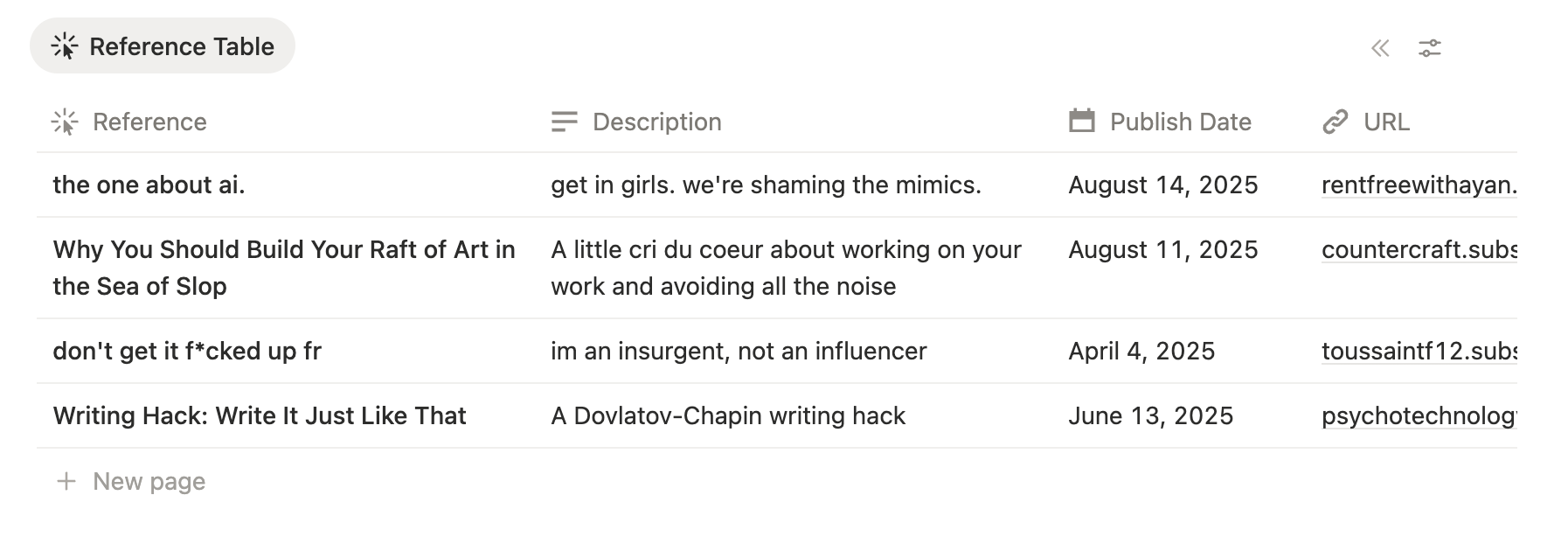
References Table Database
First thing you want to do is to look back at your consumptive habits.
It’s completely okay if you don’t read from the traditional and references. God knows how much inspiration I’ve had from obscure comments that I never saw again.
You can look at your physical library, your audible collection, YouTube history, Medium reading list, Substack stories — or maybe even just your preferred social media channels. Try to remember the references that have inspired you.
What we’re optimizing for here is resonance. Lean in to what you consume, and what gives you this renewed inspiration. In the process, you will learn how to be more mindful in your consumption because it’s true that if you consume garbage, you will produce garbage.
Personally, my main sources of inspiration are books, interviews, and when the season calls for it…essays. I read around 5-7 books in circulation. In fact, before I even deep dive into a body of work, I look into the author, their history, and inspirations. Interviews are often my gateway into their minds.
Too many references?
Lean back on your emotions.
As a practice, think of ideas encountered in what you’ve consumed that made you confront your reality. Did a character from a fiction book say something that made you rethink certain life decisions? Did a story from a non-fiction book hit too close to home?
That’s where you can start.
Sometimes, your references can even be more abstract. I often get inspired over art, conversations, and experiences.
Step 2. Trace Your Sources
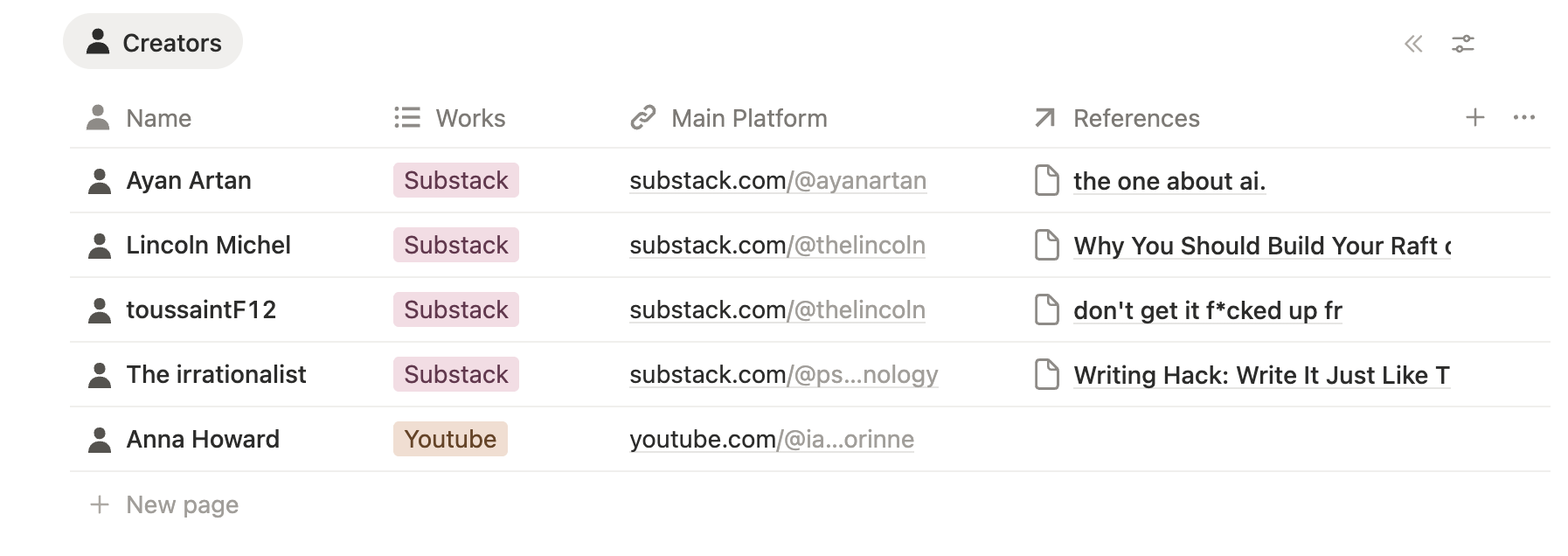
Creators Table Database
Next, you want to build the creators or artists behind those references.
I’ve created a whole database for this section to trace how many times I’ve actually quoted a certain author across their writing.
You will find a lot of truths in patterns. When you quote or reference an author multiple times, there might be something about that particular author that resonates with you. Something less tangible than just what’s written in a single publication.
This is your go signal to look into what influences the writers or artists that you favor the most. Oftentimes, you will be positively surprised by their media diet. This is how I usually find things to read or consume these days. It’s like a hidden referral system.
You can leave this blank if it’s a one-off reference, but I highly recommend building pages for authors that you’ve consumed multiple works of and want to add into your writing ecosystem.
Step 3. Write Down Your POV
No idea is ever made in isolation. Great ideas come from great inspiration.
Here, you want to pull the exact excerpts from these references and write your thoughts in a note.

Sample of a Note Page
Sometimes, it happens that you have a thought, but not a reference. You can also start with writing the note before the reference. The brain is great at connecting things, so it will come in time as long as you consume mindfully.
To make this process conducive to the concept building process, write thesis statements for titles. This makes it easier to link these micro-thoughts into the core concept of your essays.
Step 4. Build up Essays
Now, we’re finally putting things together
In the Big Ideas database, you want to identify central theme of your essays. These are ideas that you want to explore in depth.
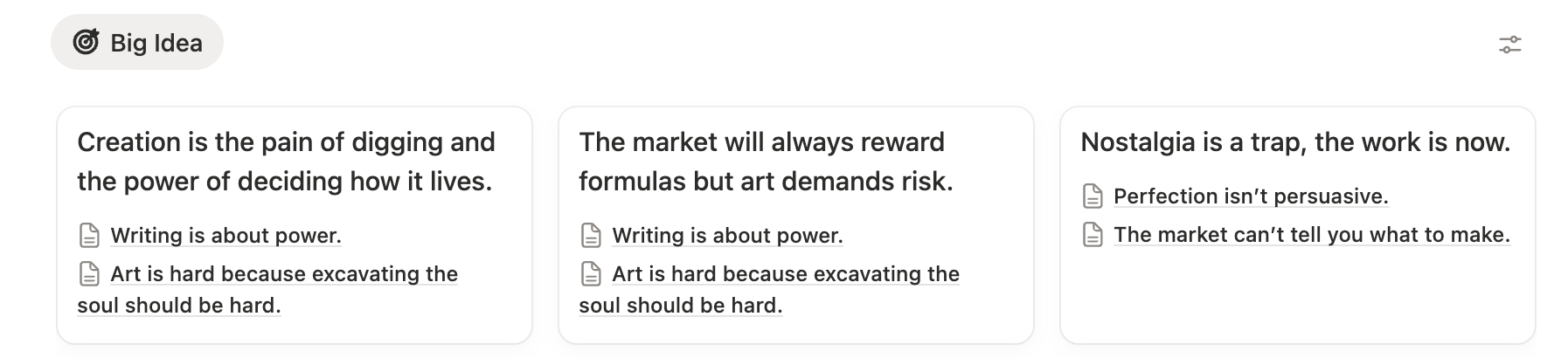
Big Ideas Database
Similar to notes, you want the big idea of this essay to have a thesis statement so it’s easier to link them to the right notes.
In practice, you can link the notes through the big idea page. From there, you can build a new essay from scratch or (what makes this magic) build from the notes you’ve already written in the past.
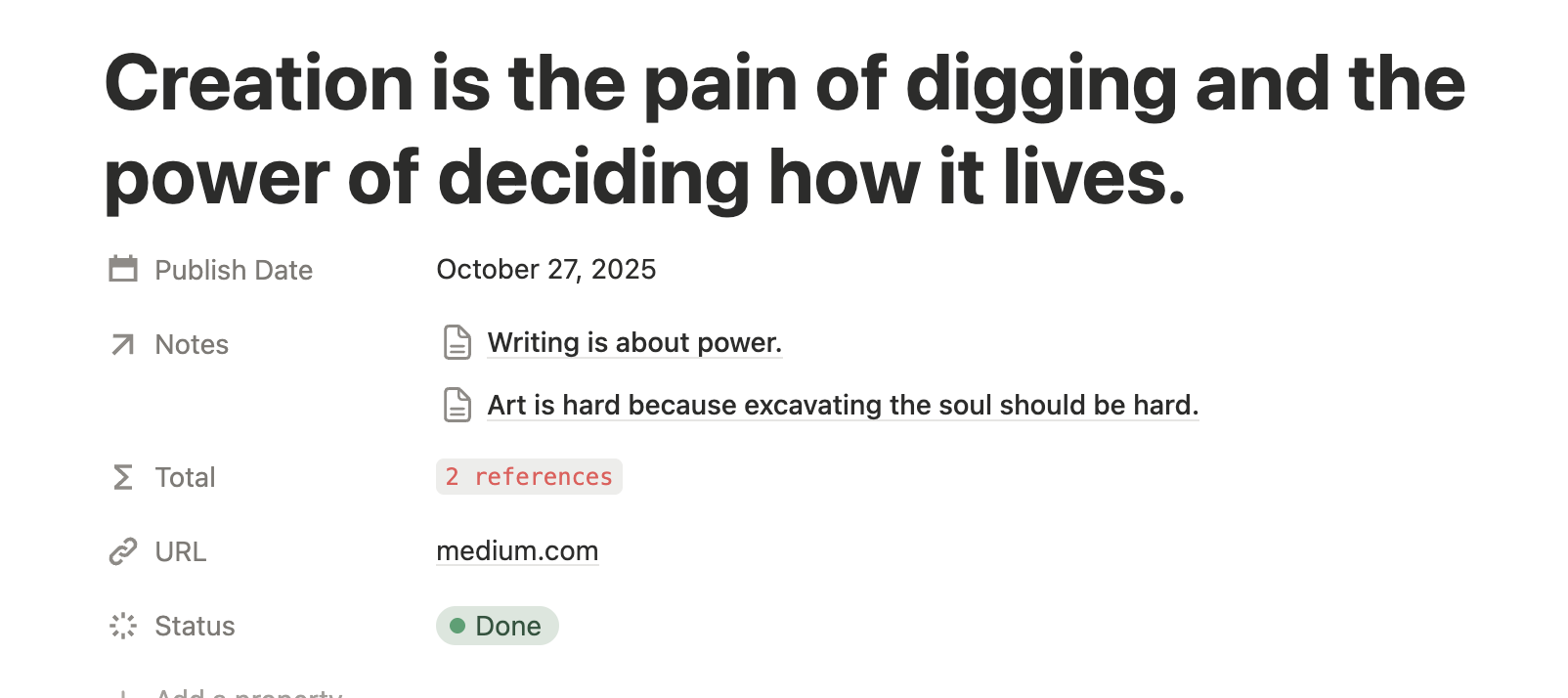
Sample of a Big Idea
Why “Big Idea”?
In copywriting, a “big idea” is the core theme or message behind a body of text or writing.
A copywriter can write up to tens of thousands of words behind marketing material form sales pages to technical copy to product descriptions — and there will and should only be one central “big idea” behind that whole universe of thought.
You can also think of this as the “core theme”.
To publish or not to publish?
You can publish or set aside your writing. Sometimes, this can act as a more structured way of journaling.
I personally have a couple of essays I don’t publish because they go a bit too personal.
In moments like these, you have to remember that the process is the point. Whatever you’ve written in the process won’t go in vain because it’s helped you rewire your brain, sometimes even open new neurological pathways or philosophies that help you cope with life better.
Building a Writing Practice
You can say this is more of a hybrid of a building and writing process.
You can add small tweaks around here to make the writing more seamless but the overarching theme of this process is to have a body of work that builds up over time:
“When nothing seems to help, I go and look at the stonecutter hammering away at his rock, perhaps a hundred times without as much as a crack showing in it. Yet at the hundred and first blow it will split in two, and I know it was not that blow that did it—but all that had gone before.” — Jacob Riis
If you need more guidance on building habits, I recommend Atomic Habits by James Clear. It’s a classic for good reason. I always pick up on new things when I do rereads.
If you’re looking for something that’s more oriented toward writing, I love Bird by Bird by Anne Lamott.
My Writing Practice
I like to use pockets of my time to just write down insights during the day. Writing the notes usually takes me 5-15 minutes, depending on whether the thought is ripe for writing or if there is enough inspiration to fuel a writing frenzy.
Usually, I’m on mobile using the shortcut buttons to capture a big idea or note on-the-go then polish everything afterwards with a wider screen desktop.
You can make this more automatic by setting a time, place, and/or device where you write — but don’t force yourself, and just work within your habit-building practices.
Terrible First Drafts
If you’re new to the writing practice, here’s what you need to know: most, if not all, first drafts are terrible. Mine are, and I never place any pressure of this first draft even being readable at first writing.
When you start this practice, it may feel unintuitive initially. But just like with any habit, it will slowly to something that runs like autopilot with enough repetition.
Start with 5-minute commitments, then 10 — then 15. I usually stop at 15, but feel free to go beyond that.
When I was in a time surplus, I would spend my first 30-45 minutes writing three essays with no pressure or expectation of it being published.
Using AI?
You can speed up this process a bit with AI, but I’d actually discourage that because taking the shortcut also trims off the neurological pathways that writing organically naturally has.
As someone who’s been hired to write professionally, AI is most useful as a way to process existing thoughts that you can’t do yourself. Maybe your brain is mentally fatigued or simply can’t think of anything to add to the argument or idea. When this happens, prompt yourself with a question — not a generated text.
Having a clear mind is one of the highest leverage tools one can have as a writer.
Customization
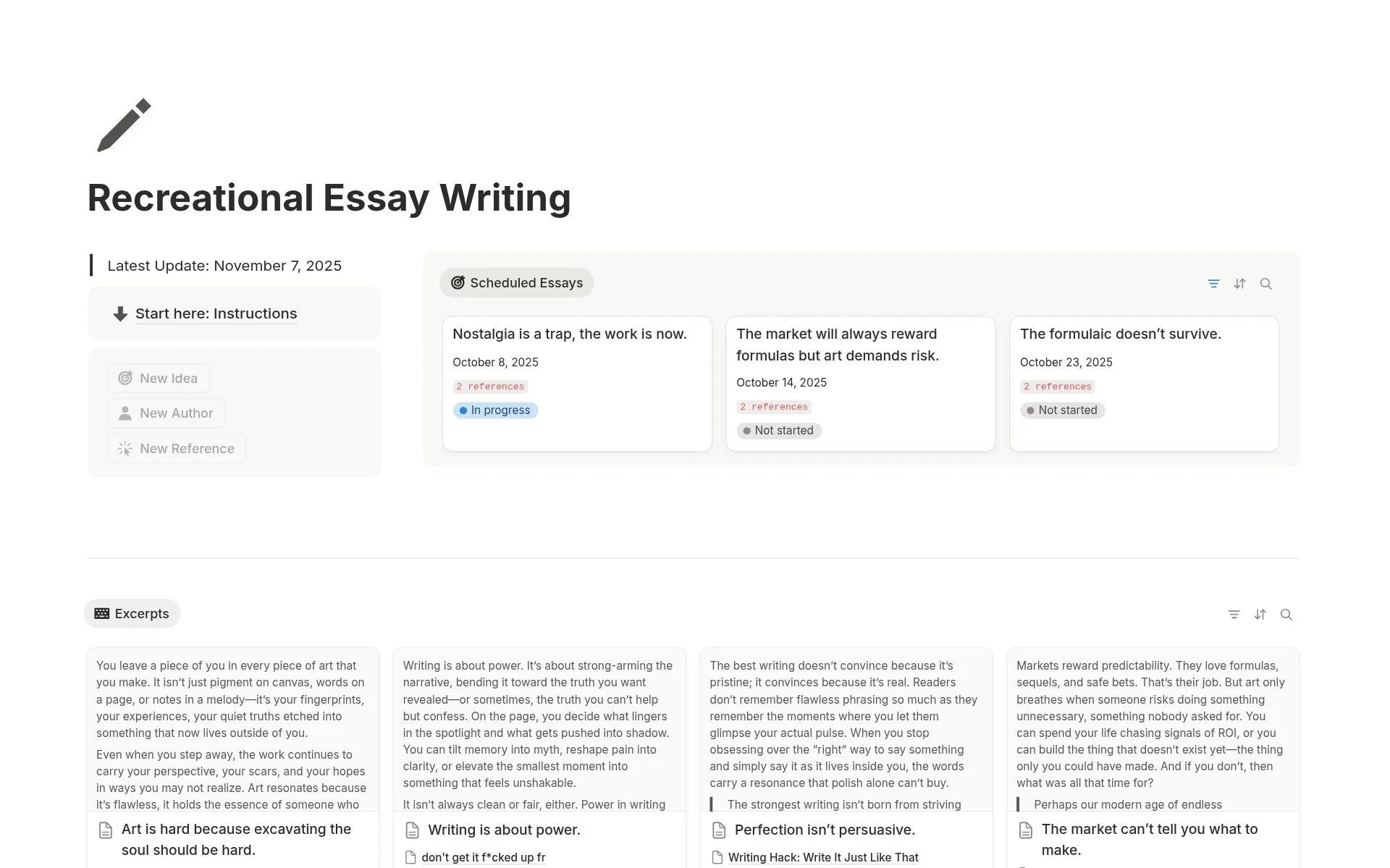
Recreational Essay Writing Template
Back to the template itself: if you think this is a little too bare for you, feel free to customize with more properties or more databases.
I would caution adding new databases or properties too early. Over time, you’ll have a better grasp of your thinking structure and workflow — and you want to optimize for when you actually have that set up.
References
These are recommended literature I’ve consumed to help build the writing practice and this system:
How to Write Smart Notes — Sonke Ahrens: This is my main reference for the Zettelkasten system that I use for this system.
Bird by Bird — Annie Lammott: This is a great reference if you’re someone in a creative rut, trying to figure out how to keep writing despite a block.
Atomic Habits — James Clear: A classic in self-development for good reason. You can pick up techniques and tricks on how to build your own writing practice. I particularly like the use of anchoring new habits on an existing one.
Note: I will start publishing newer essays in a new blog soon, and will link the website here once it goes live. :)